

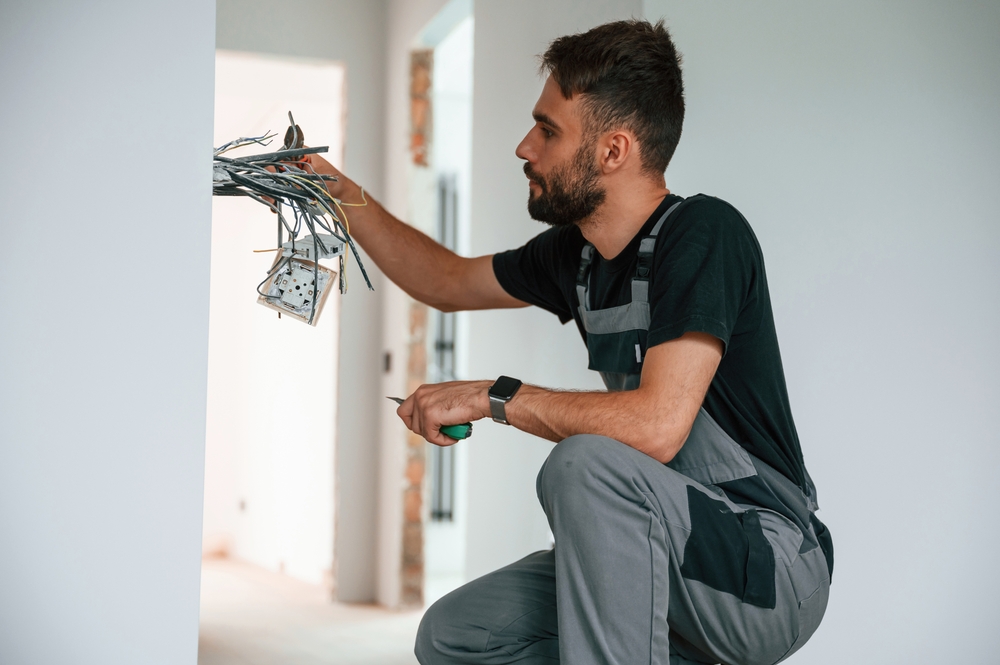
In the modern Sacramento business landscape—from the high-speed creative agencies in Midtown to the financial firms in Downtown and the burgeoning tech corridor in Folsom—a commercial building is more than just a shell. It is a “Digital Athlete.” To compete in 2025, an office must have a seamless, high-bandwidth “nervous system” where electrical power and data cabling work in perfect harmony.
For many business owners embarking on a Tenant Improvement (TI) Buildout, data and power are often treated as separate entities. IT handles the “computers,” and the electrician handles the “outlets.” However, this siloed approach is a recipe for interference, slow network speeds, and potential fire hazards.
At TNT Electric, we specialize in the Integrated Power and Data Infrastructure required for high-growth businesses. This guide is an exhaustive resource on how to design an office that is fast, reliable, and future-proofed against the next decade of technological advancement.
Part I: The Electrical Foundation for IT Infrastructure
Before you can run a single foot of Cat6 cable, you must have an electrical system that provides “Clean Power.” Modern servers and networking switches are highly sensitive to the “Dirty Power” often found in older Sacramento Commercial Buildings.
1. Dedicated Circuits for the IT Closet
Your server rack should never share a circuit with a breakroom microwave or a Warehouse Motor.
- The Problem: High-draw appliances create “Electrical Noise” (Harmonics) that can cause data packets to drop or networking hardware to reset.
- The Solution: We install Dedicated 20-Amp Circuits specifically for the IT rack, ensuring that your network has a “Clean Pipeline” of power.
2. Isolated Ground (IG) Receptacles
In a standard Commercial Office Wiring plan, the “Ground” is shared by the entire building. In an “Isolated Ground” system (identifiable by orange outlets), the ground wire runs directly back to the Main Service Panel.
- The Benefit: This eliminates “Transient Voltage” that can interfere with sensitive digital signals, making your VoIP phone systems and high-speed data transfers significantly more stable.
Part II: Structured Cabling 101 – The “Backbone” of Your Office
“Structured Cabling” is a standardized way of wiring a building for data, voice, and video. If your office looks like a “spaghetti bowl” of blue wires, your infrastructure is at risk.
1. Cat6 vs. Cat6a: The Speed Threshold
In a Sacramento Office Buildout, we typically install Category 6 (Cat6) or Category 6a (Cat6a) cabling.
- Cat6: Supports speeds up to 1Gbps at 100 meters. This is standard for most small-to-mid-sized offices.
- Cat6a: Supports speeds up to 10Gbps. For tech firms in Folsom or video editing houses in Midtown, Cat6a is mandatory to prevent bottlenecks in the workflow.
2. Fiber Optic Backbones
If your business occupies multiple floors of a Downtown Sacramento Office Tower, copper wire (Cat6) isn’t enough. We install Fiber Optic “Backbones” to connect the individual server closets on each floor, providing near-limitless bandwidth with zero distance-based signal loss.
Part III: The Interference Problem – Data vs. Power
This is where many general contractors make a critical error. Electricity creates an Electromagnetic Field (EMF). When data cables are run too close to power wires, that EMF creates “Interference” (Crosstalk) in the data line.
1. The “Two-Inch Rule”
Under the NEC and TIA standards, data cables should maintain a minimum of 2 inches of separation from power lines. In a tight Tenant Improvement Workspace, we use specialized “J-Hooks” and “Cable Trays” to keep these systems physically separate.
2. Crossing at Right Angles
If a data cable must cross a power line, it should always cross at a 90-degree angle. This minimizes the amount of time the data cable is exposed to the EMF of the power wire, preserving the integrity of your high-speed internet.
Part IV: The Server Room (The “Brain” of Your Business)
The server room is the most “Power Dense” area of your office. It requires a specific Commercial Electrical Design.
1. Cooling Coordination
A single server rack can generate as much heat as a small furnace. If the server room gets too hot, the equipment will “throttle” its speed or shut down entirely.
- Our Role: We coordinate with your HVAC team to ensure the server room has dedicated cooling. We often install VFD (Variable Frequency Drive) controls for these AC units to ensure they run efficiently year-round.
2. UPS (Uninterruptible Power Supply) Integration
A power flicker in Sacramento’s summer can cause an hour of downtime as servers reboot.
- Technical Setup: We install a central UPS or individual rack-mount battery backups. We provide the Commercial Service Work to wire these batteries into the main IT circuits, providing a seamless transition to battery power if the grid fails.
Part V: Modern Workplace Trends – Integration at the Desk
The “Modern Office” in Sacramento is moving away from the “cubicle farm” toward open-concept, “Hot-Desking” environments.
1. Motorized Standing Desks
The rise of the standing desk means every desk is now a Motorized Load.
- The Electrical Impact: If you have 50 employees all adjusting their desks at the same time, it can trip a standard 15-amp circuit. We design Office Power Plans that account for these motor loads.
2. Huddle Rooms and AV Integration
Modern offices need “Zoom-Ready” huddle rooms. This requires:
- In-Wall Power and HDMI: No more messy cables running across the floor.
- Title 24 Sensors: As part of your Commercial Compliance, these rooms must have occupancy sensors that kill the lights and the TV screens when the meeting is over.
Part VI: Cable Management & Aesthetics
In a high-end Midtown Boutique Office, aesthetics matter as much as performance.
1. Floor Boxes and “Poke-Throughs”
For open-concept offices, we use “Poke-Through” devices that bring power and data directly through the concrete floor to the center of the room. This eliminates “trip hazards” and keeps the space looking clean and professional.
2. Furniture Integration
We work with your furniture suppliers (like Steelcase or Herman Miller) to “plug-and-play” our electrical and data feeds directly into the desk “raceways,” providing a completely hidden cable management system.
Part VII: Future-Proofing with PoE (Power over Ethernet)
The future of the Sacramento Smart Building is PoE. This technology allows a single data cable to provide both high-speed internet and electrical power.
1. PoE Lighting
In some modern Office TI Projects, we are replacing traditional high-voltage wiring for lights with PoE. The lights are “Smart Devices” that plug into a networking switch, allowing for granular control of every light in the building via an app.
2. PoE Security and Access
Your cameras and “keycard” readers are almost exclusively PoE now. We provide the Commercial Data Backbone required to support these security systems, ensuring they remain online even if the building’s main power is interrupted.
Conclusion: Partner with the Hybrid Experts
Building a high-tech office in Sacramento requires an electrician who understands that the “Data Jack” is just as important as the “Power Outlet.” Don’t let your business’s growth be throttled by a 1990s approach to wiring.
At TNT Electric, we are your Integrated Technology and Power Partners. We understand the specific nuances of Sacramento TI Work and the technical requirements of the modern digital workspace. We don’t just “run wires”; we build the high-speed infrastructure that allows your business to thrive.
Is your office’s wiring holding your team back?
Contact TNT Electric today for an Office Data and Power Integration Audit.
