


If your main breaker keeps tripping while the individual breakers stay on, the problem usually involves the total load on the electrical service, the main breaker itself, or a fault inside the panel rather than an overload on one branch circuit. Each individual breaker watches its own circuit. The main breaker watches the combined electrical demand feeding the panel, so it can trip even when none of the smaller breakers has reached its own limit.
At TNT Electric Co., we see breaker problems that require more than checking which switch moved. The timing of the trip, what was running at the time, and the condition of the panel all matter. If the main breaker trips repeatedly, professional electrical troubleshooting is the safest way to find out whether the issue is load-related or a sign of damaged equipment.
Why Can the Main Breaker Trip While Individual Breakers Stay On?
A residential electrical panel divides power among multiple branch circuits. One breaker may serve kitchen receptacles, another may serve a bedroom, and larger appliances may have their own dedicated circuits.
Those branch breakers protect their individual circuits from excessive current. The main breaker sits upstream and protects the electrical service and panel as a whole. Eaton’s load center overview explains that a main breaker provides overcurrent protection for all of the branch circuits supplied by the load center.
That distinction matters because several circuits can each operate below their individual breaker ratings while their combined demand becomes too high for the main service.
For example, a home with a 100-amp main service could have the air conditioner running while an electric dryer, range, water heater, and other household loads are operating. None of those branch circuits necessarily has to exceed its own breaker rating. The combined load is what the main breaker sees.
Common Reasons the Main Breaker Keeps Tripping
The Whole House Is Drawing Too Much Power
Whole-home overload is one of the first possibilities to consider, especially if the main trips during periods of heavy electrical use.
Pay attention to whether the problem happens when several large loads overlap. Air conditioning, electric cooking equipment, clothes dryers, EV charging, pool equipment, and other high-demand equipment can add up quickly.
The pattern matters. A main breaker that trips only when several large electrical loads are operating points in a different direction than one that trips in the middle of the night with very little running.
An electrician can perform a load calculation and evaluate the actual service size rather than guessing from the number of breakers in the panel.
The Main Breaker May Be Worn or Failing
Circuit breakers are mechanical and electrical devices. They can deteriorate with age, repeated tripping, heat, or damage.
A weak main breaker may trip at a lower current than expected or become unreliable under normal household demand. The correct diagnosis requires testing because a breaker should not be replaced simply because it tripped.
Our circuit breaker replacement service starts with evaluating the breaker and panel so the repair addresses the actual cause. If the electrical load is excessive, replacing the main breaker alone does not solve that problem.
Heat or a Poor Connection May Be Affecting the Main
Loose or deteriorated connections inside an electrical panel can create resistance and heat. That heat can affect the main breaker even when individual branch circuits appear to be operating normally.
This situation deserves prompt attention because the visible trip may be only one symptom. Damage at a main connection, breaker contact, or bus connection can continue to worsen.
Do not remove the panel cover to look for the problem. Parts of electrical service equipment can remain energized even when the main breaker is switched off.
A Fault Does Not Always Trip the Breaker You Expect
Homeowners often assume a fault on a branch circuit must always trip that circuit’s breaker before anything else happens. Electrical protection does not always behave that neatly.
The location and magnitude of a fault, breaker characteristics, equipment condition, and how the protective devices interact can affect which breaker opens. A fault involving the panel bus or equipment between the main breaker and the branch breakers may leave the individual breakers set while the main opens.
That is one reason repeated main-breaker trips need actual testing rather than trial-and-error breaker replacement.
The Timing of the Trip Gives Useful Clues
Before scheduling service, note what happens immediately before the main breaker trips. You do not need to open the electrical panel or test live equipment to gather useful information.
Write down which major appliances were running and whether the trip happened right when one of them started. Notice whether the problem occurs mainly during the hottest part of the day, when household electrical demand tends to be higher, or whether it seems random.
Also pay attention to the extent of the outage. If the whole house loses power but the main breaker is still firmly in the ON position, the problem may be outside the panel, including a utility outage. If the main breaker has physically tripped, that gives the electrician a different starting point.
A single unexplained trip is worth watching closely. Repeated trips establish a pattern that should be diagnosed.
When You Should Stop Resetting the Main Breaker
Do not keep cycling a main breaker that repeatedly trips. Resetting it over and over does not correct an overload, damaged connection, failing breaker, or electrical fault.
If the breaker trips again immediately, leave it off and call an electrician. The same applies if you notice a burning odor, buzzing or crackling from the panel, discoloration, visible damage, or unusual heat around the panel enclosure.
If the breaker tripped once during an obvious period of unusually heavy electrical use and there are no warning signs at the panel, reducing the electrical load before one reset may restore power. If it trips again, stop there.
Never replace the main breaker with a larger one to keep it from tripping. Breaker and service ratings are part of the electrical system’s protection. Increasing the breaker size without determining whether the service and equipment are rated for it can create a serious hazard.
Does a Tripping Main Breaker Mean You Need a Panel Upgrade?
Not automatically.
If testing shows that the main breaker itself has failed and the panel is otherwise in good condition, the repair may be limited to the appropriate breaker work. A damaged bus or other panel problem can require a larger repair.
Homes that regularly exceed the capacity of their existing electrical service may need a different solution. That becomes more common as homeowners add electric appliances, HVAC equipment, EV charging, additions, or other substantial loads.
Our electrical panel upgrade service includes evaluating the existing panel, service size, circuits, and electrical demand before recommending an upgrade. The decision should come from the condition and capacity of the system, not simply from the fact that a breaker tripped.
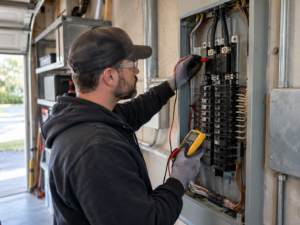
What an Electrician Checks When the Main Breaker Keeps Tripping
The diagnostic process should separate a whole-home capacity problem from a breaker or panel failure.
An electrician may evaluate the main breaker, measure electrical demand, inspect accessible panel components for signs of overheating or damage, and check whether the trip corresponds with a particular appliance or group of loads. The electrical service size and the home’s overall demand also need to make sense together.
If the problem points to a fault rather than ordinary overload, troubleshooting continues until the source is identified. Replacing parts before locating the cause can leave the original problem in place.
Get a Repeated Main Breaker Trip Checked
A main breaker that trips while every individual breaker stays on is possible because the main protects the combined electrical load and equipment feeding those circuits. Sometimes the house is drawing more power than the service should carry. In other cases, the main breaker or panel needs repair.
If your main breaker keeps tripping in Citrus Heights or the surrounding Sacramento area, contact TNT Electric Co. to schedule an electrical evaluation. Note what was running before each trip and any heat, sound, or odor near the panel. Those details give us a useful starting point, but repeated main-breaker trips should be diagnosed rather than repeatedly reset.
Our Services at a Glance
At TNT Electric, we are a licensed electrical company based in Citrus Heights, CA, proudly serving the Sacramento area with dependable, professional service.
View Services

