

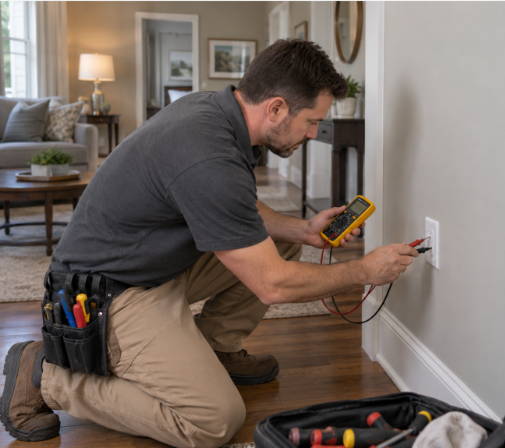
If an outlet keeps losing power, comes back on, then cuts out again while the breaker stays in the ON position, the problem is usually somewhere along the circuit rather than something you can diagnose from the breaker handle alone. A loose electrical connection, a worn receptacle, a GFCI upstream, or a failing breaker can interrupt power without an obvious trip. Because loose connections can overheat, repeated power loss deserves attention even if the outlet starts working again.
At TNT Electric Co., we handle problems like this through professional electrical troubleshooting. The key is to trace where power stops instead of replacing parts based on a guess.
Why an Outlet Keeps Losing Power Without Tripping the Breaker
A circuit breaker responds to electrical conditions such as an overload or short circuit. It does not trip every time electricity stops reaching an outlet.
If a connection becomes loose or partially opens, power can become intermittent without the circuit drawing enough current to trip the breaker. The breaker may look normal while one outlet, or several outlets farther down the same circuit, lose power.
This is why the breaker position only tells you part of the story. The receptacle, other devices on the circuit, GFCI protection, wiring connections, and the breaker’s actual electrical output may all need to be checked.
Start by Paying Attention to the Pattern
Before doing anything beyond basic checks, notice exactly what is happening. The pattern often gives an electrician useful clues about where the failure sits.
Ask yourself:
- Does only one outlet lose power, or do several outlets go dead at the same time?
- Does the power return on its own, or only after someone resets a GFCI or breaker?
- Does the problem happen when a particular appliance starts running?
- Are nearby lights, switches, or receptacles affected too?
- Does a plug fit loosely or fall out of the outlet more easily than it should?
You can test the outlet with a small device that you already know works, such as a lamp. If the receptacle is warm, discolored, buzzing, sparking, or smells burned, skip testing it and stop using it.
Avoid removing the outlet cover or pulling the receptacle from the wall. A connection can remain energized even when the symptom looks like a simple dead outlet.
Check for a GFCI on the Same Circuit
A standard-looking outlet can receive power through a GFCI receptacle located somewhere else. One GFCI may protect several downstream receptacles, so the device controlling your dead outlet may be in a garage, bathroom, kitchen, laundry area, or outside.
Look for outlets with TEST and RESET buttons. If you find a tripped GFCI, unplug equipment on the affected circuit and press RESET once.
The Electrical Safety Foundation International’s GFCI guidance explains how to test and reset these devices. If the GFCI will not reset or trips again, the circuit needs further attention.
There is an important distinction here. If the outlet stays dead until you reset a GFCI, the GFCI is intentionally opening the circuit. If the outlet loses power and later comes back without anyone resetting anything, a loose connection or failing component becomes more likely.
A Loose Connection Can Make Power Come and Go
Loose connections are one of the first things to consider with intermittent outlet power. The problem may sit at the affected receptacle, but it can also be at another outlet or connection earlier on the same circuit.
Many residential branch circuits feed multiple devices in sequence. If one connection in that path becomes unreliable, everything downstream from it may lose power even though the breaker remains on.
A poor connection can create resistance and heat. That is why an outlet that starts working again should not automatically be treated as fixed. Intermittent contact is still a fault.
The Receptacle Itself May Be Worn Out
Outlets wear with use. Internal contacts can lose their grip, and terminals or other components can deteriorate.
A plug should sit firmly in the receptacle. If cords sag, fall out, or feel unusually loose, stop using that outlet until it is replaced. Cracks, browning, scorch marks, or deformation around the slots are also reasons to leave it alone.
Sometimes an outlet still supplies power to a small device but cuts out under a heavier load. That does not prove the appliance is the problem. The receptacle or connection may be struggling under load, which requires proper testing.
The Breaker Can Be Faulty Even If the Handle Looks Normal
A breaker that has not visibly tripped is not automatically healthy. Less often, the breaker itself may have an internal problem or poor connection that interrupts power to the circuit.
Our circuit breaker replacement service covers situations where a breaker is worn, damaged, or no longer operating correctly. An electrician should verify that the breaker is actually supplying the expected voltage before deciding to replace it.
Replacing a breaker without testing the circuit can miss the real problem. If a loose receptacle connection sits downstream, a new breaker will not correct it.
What It Means When Several Outlets Lose Power Together
If multiple outlets go dead at the same time, look at what they have in common. They may share the same branch circuit or sit downstream from the same GFCI or wiring connection.
You do not need to open electrical boxes to gather useful information. Note which outlets still work, which ones do not, and whether lights in the same area are affected. That basic map gives the electrician a better starting point.
A failure at one upstream device can interrupt power to several outlets after it. The outlet closest to the apparent problem is not always the outlet causing it.
Stop Using the Outlet if You Notice a Safety Warning
Intermittent power becomes more urgent when the outlet shows signs of heat or arcing. Stop using the affected receptacle if you notice:
- Heat at the outlet or faceplate
- A burning or melting-plastic odor
- Buzzing, crackling, or sizzling sounds
- Visible sparks or scorch marks
- A plug that no longer fits securely
If you can positively identify the affected circuit and safely reach the electrical panel, switch that circuit off until it is inspected. Do not repeatedly reset a breaker or GFCI that will not stay on.
What an Electrician Checks for Intermittent Outlet Power
Professional troubleshooting follows the circuit instead of assuming the outlet itself has failed. Depending on the symptom, an electrician may verify power leaving the panel, test the affected receptacle, identify upstream devices, inspect accessible connections, and evaluate the breaker.
The electrician will also check whether a GFCI or AFCI device is part of the circuit and whether the problem appears only under load. Voltage testing at different points shows where normal power stops or becomes unstable.
Two homes with the same symptom may need different repairs. One may have a worn receptacle. Another may have a loose upstream connection that affects half a room. The problem could also sit closer to the panel.
Finding the actual failure point prevents unnecessary replacement work and addresses the condition causing the outage.
When to Call TNT Electric Co.
A single tripped GFCI that resets and continues working may have a straightforward explanation. An outlet that repeatedly loses power, returns on its own, affects other receptacles, or shows any sign of overheating needs a closer look.
If you’re in Citrus Heights and your outlet keeps losing power while the breaker stays on, contact TNT Electric Co. to schedule electrical troubleshooting.
Until the cause is identified, do not rely on the fact that the breaker looks normal. Check for an upstream GFCI, note which other devices lose power, and stop using any outlet that feels warm, looks damaged, or behaves intermittently.
Our Services at a Glance
At TNT Electric, we are a licensed electrical company based in Citrus Heights, CA, proudly serving the Sacramento area with dependable, professional service.
View Services

