


A 30-amp RV outlet is usually the right choice when your RV has a 30-amp shore-power cord and you only need to operate a smaller collection of appliances. A 50-amp outlet makes sense for larger RVs with 50-amp service, especially if you want to run multiple air conditioners or other high-demand equipment at the same time. Your RV’s factory connection should guide the decision, but your home’s electrical capacity and future plans matter too.
At TNT Electric Co., we handle dedicated circuit and outlet work for homeowners in Citrus Heights and throughout Greater Sacramento. Before an RV outlet installation, we look at the RV’s electrical requirements, the proposed parking location, the distance from the panel, and the capacity of the existing service.
What Is the Difference Between a 30-Amp and 50-Amp RV Outlet?
A 30-amp RV outlet and a 50-amp RV outlet don’t simply provide different amounts of the same electrical service. They use different receptacles, wiring configurations, breakers, and power capacities.
Most 30-amp RVs use a three-prong TT-30 connection. It supplies 120 volts through one hot conductor, one neutral, and one equipment grounding conductor. At 30 amps, the connection has a theoretical capacity of 3,600 watts.
A typical 50-amp RV connection uses a four-prong NEMA 14-50 receptacle. It supplies two 120-volt hot legs, a neutral, and a ground. Each hot leg can carry up to 50 amps, giving the RV access to as much as 12,000 watts across both legs.
That difference is substantial. A 50-amp RV connection has over three times the total power capacity of a 30-amp connection, not merely 20 additional amps.
The RV Industry Association’s electrical safety guidance also emphasizes the importance of proper grounding, polarity, and receptacle condition for both 30-amp and 50-amp RV electrical systems.
Start With the Plug on Your RV
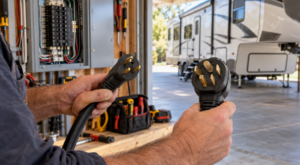
Check the RV’s shore-power cord before choosing an outlet. A 30-amp RV plug has three prongs, while a 50-amp plug has four.
The owner’s manual or electrical label should also identify the required service. Match the new receptacle to that specification whenever possible. Installing the matching outlet avoids unnecessary adapters and gives the RV the type of power its electrical distribution system expects.
Do not assume the RV needs 50-amp service solely because it’s large. Some travel trailers and older motorhomes still use 30-amp connections. Likewise, a compact but well-equipped RV may have a 50-amp service because it contains multiple air conditioners or several electric appliances.
If you haven’t purchased the RV yet, bring the model’s electrical specifications to the estimate. Planning around the actual equipment produces a better result than choosing a receptacle based on a future RV’s approximate size.
When a 30-Amp RV Outlet Is Usually Enough
A 30-amp outlet often works well for travel trailers, smaller motorhomes, and RVs that already use a TT-30 shore-power cord.
With 3,600 watts available, you still need to manage which appliances operate together. An air conditioner can consume a significant part of the available capacity, particularly when its compressor starts. Running the air conditioner, microwave, electric water heater, and other equipment simultaneously may overload the RV’s 30-amp service.
That limitation doesn’t make 30-amp service inadequate. It simply means the RV owner has to pay attention to combined electrical demand.
A matching 30-amp RV outlet may be the practical choice if you:
- Own a 30-amp RV and don’t plan to replace it soon
- Usually operate one air conditioner
- Use propane for some appliances
- Want shore power for loading, cleaning, or preparing the RV at home
- Don’t need every major electrical appliance running simultaneously
The receptacle still needs a correctly sized dedicated circuit. An ordinary outdoor household outlet doesn’t become a 30-amp RV connection through an adapter.
When a 50-Amp RV Outlet Makes More Sense
A 50-amp connection suits larger fifth wheels, motorhomes, and trailers equipped with 50-amp shore power. The added capacity supports more equipment at once and reduces the amount of day-to-day load management required inside the RV.
This service becomes especially useful with two air conditioners, electric cooking equipment, a washer and dryer, or other higher-demand features. The RV distributes its 120-volt loads across the two hot legs rather than drawing everything from one 30-amp supply.
A 50-amp RV outlet installation may also make sense if you currently own a 30-amp RV but expect to upgrade to a 50-amp model. Whether that future planning is worth the added electrical work depends on your panel, circuit route, and budget.
Installing a 50-amp receptacle doesn’t force the RV to draw 50 amps continuously. The RV draws power according to the equipment that’s operating. The larger circuit makes more capacity available when the RV needs it.
Can You Plug a 30-Amp RV Into a 50-Amp Outlet?
A properly selected RV adapter lets a 30-amp RV connect to a 50-amp receptacle. The RV’s own 30-amp main breaker still limits what its electrical system can use.
The adapter doesn’t convert the RV into a 50-amp system or increase its internal capacity. You’ll still have approximately 3,600 watts available inside a 30-amp RV.
A 50-amp RV can also connect to a 30-amp outlet with the appropriate adapter, but available power drops sharply. You may need to run only one air conditioner and limit the use of other electric appliances.
Adapters work best as temporary compatibility tools. If the RV will remain connected at home regularly, a matching receptacle gives you a cleaner setup with fewer connection points.
An RV Outlet Is Not the Same as a Dryer Outlet
A 30-amp RV receptacle usually supplies 120 volts. Many residential dryer receptacles supply 240 volts.
The similar amperage ratings create a dangerous opportunity for confusion. Wiring a TT-30 RV receptacle as if it were a 240-volt dryer outlet can send the wrong voltage into the RV and damage appliances, electronics, or the electrical system.
A 50-amp NEMA 14-50 receptacle does have two hot legs, but that doesn’t mean any existing 14-50 outlet is automatically ready for RV use. The circuit, receptacle condition, conductor size, grounding, breaker, and installation environment all require evaluation.
Never rely on the receptacle’s appearance alone. An electrician should test and verify an existing outlet before you connect an RV to it.
Your Electrical Panel Still Needs Enough Capacity
An open breaker space doesn’t prove that a panel has enough capacity for a new RV circuit.
An electrician should consider the home’s existing electrical demand, service size, and major loads. Air conditioning, electric water heating, an electric range, a dryer, a pool, and an EV charger can already place substantial demand on the service.
The evaluation may show that the existing panel supports the RV circuit without major changes. Another property may need a subpanel, service modification, or electrical panel upgrade before adding the outlet.
Circuit distance matters as well. An outlet installed beside the main panel usually requires a different amount of material and labor than one placed across the property near a detached parking area. Longer runs also require attention to conductor sizing and voltage drop.
Our electrical services in Citrus Heights and Greater Sacramento include panel work, dedicated circuits, subpanels, troubleshooting, and other residential electrical projects that may be involved in an RV hookup.
Where Should the RV Outlet Go?
Place the receptacle where the RV’s factory power cord can reach without sitting under tension or crossing a driveway or primary walkway.
Think about how the RV will enter the parking space and where its shore-power connection sits. A motorhome with its electrical connection near the rear may need a different outlet position than a travel trailer with a connection closer to the front.
Outdoor equipment must suit its environment. The installation may require a weather-resistant enclosure, an in-use cover, appropriate mounting, grounding, and circuit protection based on the outlet’s location and the code currently adopted by the local jurisdiction.
Avoid planning around a long extension cord. Longer cords create extra connection points and can contribute to voltage drop, particularly under heavy loads. A correctly located permanent outlet usually works better for regular use.
What Determines the Cost of RV Outlet Installation?
The amperage affects the cost, but it isn’t the only factor. A 50-amp circuit generally requires larger conductors than a 30-amp circuit, which can raise material costs.
The final scope also depends on:
- The distance between the panel and RV parking space
- Whether the wiring can run through an accessible attic, crawlspace, garage, or exterior route
- The condition and capacity of the existing electrical panel
- Whether a subpanel or panel modification is necessary
- Trenching or underground conduit requirements
- The mounting location and type of outdoor enclosure
- Permit and inspection requirements
A site evaluation gives the electrician enough information to determine the circuit route and identify any panel limitations before work begins.
Choose the Outlet That Matches How You’ll Use the RV
For an RV with 30-amp factory service, a dedicated 30-amp outlet usually gives you the connection you need without installing excess capacity. If the RV has 50-amp service, matching it with a 50-amp receptacle lets you use its electrical equipment with fewer restrictions.
Future plans may justify installing 50-amp service now, but the panel and circuit route need to support that choice. The outlet must also be wired for RV use rather than treated like a standard dryer or appliance connection.
If you’re planning an RV outlet installation in Citrus Heights or the Greater Sacramento area, contact TNT Electric Co. with the RV model, plug type, and proposed parking location. We can evaluate the electrical panel and determine which dedicated circuit fits the RV and the property.
Our Services at a Glance
At TNT Electric, we are a licensed electrical company based in Citrus Heights, CA, proudly serving the Sacramento area with dependable, professional service.
View Services

